


Home / Blog & Insights / H-1B
H-1B visa: key facts, requirements, and free resources
What is the H-1B Visa?
A nonimmigrant work visa letting a U.S. employer hire a foreign worker in a specialty occupation. Under INA 214(i)(1) (8 U.S.C. 1184(i)(1)), a specialty occupation requires a U.S. bachelor's degree or its equivalent in a specific specialty. Employer-sponsored only — no self-petition.

Key H-1B Facts
H-1B Basics
The H-1B visa enables U.S. employers to hire high skilled foreign professionals in specialty occupations such as technology, engineering, finance, healthcare, and education.
It can provide up to six years of work authorization, permits “dual intent,” meaning a worker may pursue permanent residence without jeopardizing H-1B status, and allows eligible spouses and children to accompany the worker. The H-1B can offer a practical pathway to build a long-term career in the United States, while helping employers fill roles that require specialized knowledge and advanced qualifications.
85,000 slots/year
65,000 regular cap + 20,000 for U.S. master's-degree holders
High demand, insufficient supply
FY2024: about 781,000 registrations for 85,000 openings
Cap-exempt employers
Higher education and certain nonprofit/government research organizations aren't counted against the cap.
Length of status
Up to 3 years initially, extendable to 6 (further extensions possible with a pending green card case)
Big economic benefits for the United States
Estimates range from about 2 to 7+ jobs per H-1B approval, depending on methodology. Read about H-1B misperceptions here.
PNAE/AEI (2011) found 1.83 jobs for U.S.-born workers per additional H-1B; a study cited by the American Immigration Council found 3.1 jobs at the same firm; NFAP has cited figures as high as 7.5 jobs per position requested.
Eligibility
Eligibility and qualifications: the specialty occupation role requirement
Specialty Occupation
The position itself must require theoretical and practical application of highly specialized knowledge
Beneficiary Qualifications
The beneficiary must actually hold that specific-field degree, or its equivalent through experience or a formal credential evaluation
Employer as petitioner
The employer, not the beneficiary, is the petitioner — there is no self-petition mechanism
The most common issues are known
The five most common reasons for RFEs are:
1. specialty occupation position, 2. employer-employee relationship, 3. availability of work off-site, 4. beneficiary qualifications, and 5. maintenance of status.
In-depth: The position must qualify as a specialty occupation, and the beneficiary must possess the qualifications required to perform the role.
First, the position and its key responsibilities must require the theoretical and practical application of highly specialized knowledge. This is normally demonstrated by requiring at least a bachelor’s degree in a directly related specific specialty, rather than simply requiring a bachelor’s degree in any field. USCIS provides more information about the H-1B specialty-occupation requirements.
The beneficiary must also be qualified through a relevant U.S. degree, an equivalent foreign degree, or an appropriate combination of education, specialized training, and progressively responsible experience.
When the position’s degree requirement or the beneficiary’s qualifications are not sufficiently established, USCIS may issue a Request for Evidence. Specialty-occupation eligibility has historically been among the most common issues raised in H-1B RFEs.
ProfVal’s H-1B Expert Opinion Letters address these issues through a research-backed, expert-signed analysis explaining why the position requires specialized education and how the beneficiary’s academic and professional background satisfies that requirement.
When a beneficiary earned a degree outside the United States, a credential evaluation may help establish that the foreign education is equivalent to a relevant U.S. degree.
Also allows some other roles
Fashion models of distinguished merit and certain DOD cooperative research workers, outside the specialty-occupation standard
H-1B JOBS & EMPLOYERS (General Trends)
H-1B Employer Trends
For most of the program's history, Indian IT services and staffing firms like Cognizant, TCS, Infosys, Wipro, HCL filed the largest volumes.
Large direct employers (Amazon, Google, Meta, Microsoft, Apple) and finance/consulting firms have also consistently ranked among the top sponsors.
Interesting fact:
FY2025 marked the first year Amazon, Meta, Microsoft, and Google took all four top spots for new-hire approvals, displacing the Indian IT services firms that had historically dominated.

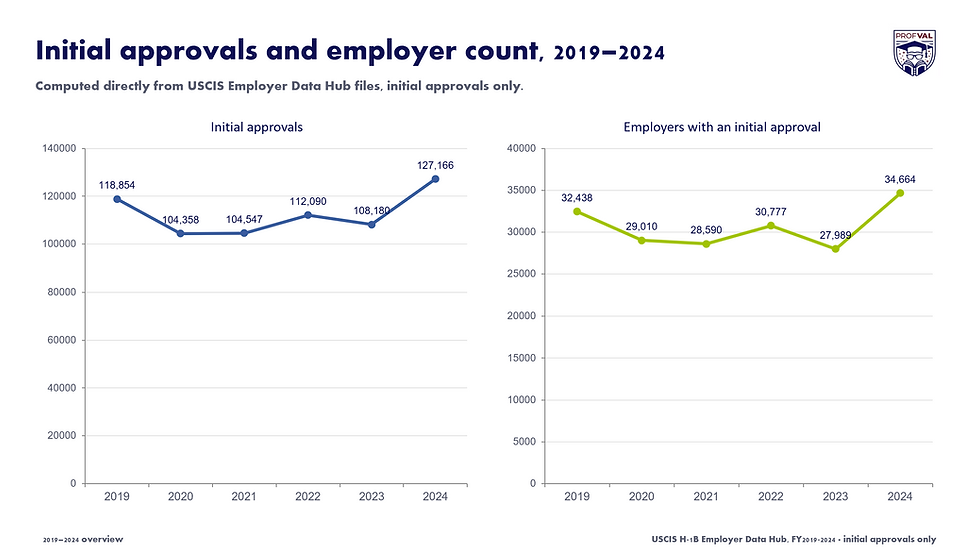
Thousands of companies benefit from H-1B workers.

Describe your image
H-1B JOBS & EMPLOYERS (By year)
2024 H-1B Approvals
INSIGHTS
-
62.4% of all 34,664 sponsors (21,636 employers) filed exactly one initial approval. Just 105 employer entries (0.3%) with 101+ approvals accounted for 19.2% of all approvals — the mean overstates what a typical sponsor looks like.
-
Microsoft and IBM, 2023's top two leaders (977 and 944), show combined totals under 15 each in the 2024 file under those exact names.
-
Typical sponsor has 1 role, but large sponsors lead to a larger average: Mean: 3.7 / Median: 1 / Mode: 1


Most employers had one (1) hire, so larger employers increased the average number of hires.

The vast majority of employers had 1-10 approvals.
2021 H-1B Approvals

SUMMARY
TOTAL EMPLOYERS
45,680
TOTAL ROLES
141,194
TOP 10 EMPLOYERS
1. Infosys (5,256) · 2. Amazon (4,849) · 3. TCS (3,063) · 4. Wipro (2,121) · 5. Cognizant (1,481) · 6. Google (1,453) · 7. IBM (1,399) · 8. Microsoft (1,240) · 9. HCL America (1,209) · 10. Facebook (1,196)
INSIGHTS
Infosys overtook Amazon for #1, the only year in this span an Indian IT firm led.
Wipro jumped from 15th place in 2020 to 4th in 2021, the sharpest single-year swing among major sponsors.
Full breakdown → h1bexpert.com
2022 H-1B Approvals

SUMMARY
TOTAL EMPLOYERS
51,672
TOTAL ROLES
138,380
TOP 10 EMPLOYERS
1. Amazon (3,296) · 2. Infosys (3,117) · 3. TCS (2,722) · 4. Cognizant (2,447) · 5. Google (1,562) · 6. Meta (1,378) · 7. IBM (1,236) · 8. HCL America (1,170) · 9. Accenture (1,082) · 10. Capgemini (1,066)
INSIGHTS
Amazon overtook Infosys for the #1 spot, reversing 2021's order.
Professional, Scientific & Technical Services alone accounted for 24,809 approvals, nearly 4x the #2 industry (Manufacturing, 6,515).
2023 H-1B Approvals

SUMMARY
TOTAL EMPLOYERS
27,989
TOTAL ROLES
108,180 (96.2% approval rate)
TOP 5 EMPLOYERS (single entity)
1. Microsoft (977) · 2. IBM (944) · 3. Wipro (862) · 4. Meta (724) · 5. Apple (692)
INSIGHTS
2022's leaders (Amazon, Infosys, TCS, Cognizant, Google) fell out of the top of the single-entity list — both from splitting filings across more subsidiaries and a real decline in filing volume at those firms.
A mainstream U.S. tech company (Microsoft) led the single-entity ranking for the first time in recent memory, rather than an IT outsourcing firm.
2019 H-1B Approvals

SUMMARY
TOTAL EMPLOYERS
11,916
TOTAL ROLES
132,967
TOP 10 EMPLOYERS
1. Amazon · 2. Google (Alphabet) · 3. Tata Consultancy · 4. Microsoft · 5. Cognizant, 6. Facebook, 7. IBM, 8. Deloitte Consulting, 9. Apple, 10. Intel
INSIGHTS
Just 9 firms (under 0.1% of sponsors) with 1,000+ hires accounted for 11.6% of all approvals.
94.5% of all sponsoring employers hired 25 or fewer H-1B workers all year.
2020 H-1B Approvals

SUMMARY
TOTAL EMPLOYERS
27,808
TOTAL ROLES
122,893
TOP 10 EMPLOYERS
1. Amazon · 2. Infosys · 3. TCS · 4. Cognizant · 5. Microsoft · 6. Google · 7. Capgemini · 8. HCL America · 9. IBM · 10. Facebook
INSIGHTS
The 11 firms with 1,000+ hires accounted for 22,499 approvals combined, about 18% of the year's total from under 0.04% of employers.
Full breakdown → h1bexpert.com
H-1B Selection & History
How H-1B selection has worked, and why it changed
The cap hasn't always been allocated the same way. The shift from random selection to today's weighted system says a lot about what regulators believe is going wrong with the program.

Historical milestones (1990-2026)
1990 — Creation (Pub. L. 101-649)
Sen. Kennedy (D) introduced, Pres. Bush (R) signed. Senate 89-8, House 264-118. Cap: 65,000.
1998 & 2000 — Cap raised
ACWIA (115,000) then AC21 (195,000); portability added; higher-ed/research nonprofits exempted.
2004 — H-1B Visa Reform Act
Cap reverts to 65,000 + 20,000 master's-degree allotment. Reached every year since.
(1990-2026)
Electronic registration (2020), then beneficiary-centric selection (March 2024) to curb duplicate registrations.
2025 — H-1B Modernization Rule
Effective Jan 17, 2025: revised specialty occupation definition, longer cap-gap, codified deference, expanded site visits. Also narrowly touches L-1, O, and TN.
2025-2026 — $100,000 fee: under litigation
Sept. 2025 proclamation vacated by a district court June 8, 2026; First Circuit denied a stay July 24, 2026. Currently unenforced, litigation ongoing.
2026 — Weighted, wage-level selection replaces random lottery
DHS final rule effective Feb 27, 2026, in place for the FY2027/March 2026 registration season. Registrations are now entered into the pool multiple times based on wage level — Level IV roles get 4 entries, Level I roles get 1 — replacing the pure random draw used since the cap began. See "How H-1B selection actually works" below for the full breakdown.
A shift from lottery to a qualifications-based system
Initially, the H-1B selection began as a random "lottery". The random nature of the program was meant to promote efficiency within the U.S.C.S. and equity.
Why it started as a random lottery When the 65,000 cap was created in 1990, petitions were processed first-come-first-served — the same model used for most immigration benefits. That worked fine as long as demand stayed below the cap. By the mid-2000s it didn't: the cap for FY2008 was reached within a single day, with roughly 150,000 petitions competing for 65,000 slots. USCIS needed a way to choose fairly among petitions filed on the same qualifying day, and it settled on a random, computer-generated lottery. The reasoning was straightforward: a lottery doesn't require USCIS to make subjective judgment calls about which equally-qualified petition is "better," and it doesn't reward employers simply for having the fastest couriers or biggest legal teams able to file within the first hours of the window. Every properly filed petition got the same odds, regardless of company size or the wage offered. Electronic registration (2020) and beneficiary-centric selection (2024) refined how that lottery was administered — cutting employer costs for unsuccessful entries and closing a loophole where related companies filed duplicate registrations to improve their odds — but selection itself stayed random for over 15 years.
Why did it change in 2026?
A preference for higher wage roles. DHS's stated rationale for ending random selection is that it had been "exploited and abused by US employers who were primarily seeking to import foreign workers at lower wages than they would pay American workers." Because every registration got equal odds regardless of wage, an employer that registered many workers for lower-paid, lower-level roles had the same per-registration chance of selection as an employer offering a smaller number of highly-paid, senior positions — which meant filing volume, not wage level, effectively determined how many chances an employer got. This is the same dynamic behind the employer-trends data above: Indian IT staffing firms historically filed enormous volumes at lower wage levels, while Big Tech filed fewer, higher-paid registrations. A weighted system directly counteracts that by making wage level, not just filing volume, the thing that improves your odds.
How H-1B selection works (2026 onward)
Major change: As of February 27, 2026, selection is no longer a simple random lottery. A DHS final rule now weights each registration by wage level — effective in time for the FY2027 cap season (March 2026 registration window).
Entries in the selection pool, by OEWS wage level
Level 1
48% reduction in odds
Level 2
3% improved odds
Level 3
55% improved odds
Level 4
107% improved odds
Each registration is entered into the pool a number of times equal to its wage level — a Level IV registration (senior roles requiring independent judgment) is entered 4 times for every 1 entry a Level I registration (entry-level roles) gets. Employers must report accurate SOC code, wage level, and worksite location at registration, and USCIS verifies that against the petition later.
This mechanically favors the employers already leading the employer-trends rankings above — Amazon, Meta, Microsoft, and similar high-wage direct employers — and works against the smaller employer or entry-level hire that historically relied on a random draw for a fair shot. It also raises the stakes on wage-level accuracy: understating a role's wage level to game the system now risks a mismatch USCIS can catch at the petition stage.
Sourced from the DHS final rule (effective Feb. 27, 2026) and contemporaneous immigration-law analysis; a court challenge is plausible given the scale of the change. Current as of Aug 2026, may change. Not legal advice.
H-1B Career Advice
H-1B Job Search and Career Advice
Learn what experts say about getting a job on an H-1B. Look at resources to find your H-1B job.
Where should I search?
University Career Center & LinkedIn
Your career center will post jobs from companies specifically hiring from your college or university.
LinkedIn can be a great way to connect with alumni who will be able to help you find your first role.
Indeed, Monster, Glassdoor, Dice
Places like Indeed, Glassdoor, and Dice list jobs, often with roles that include sponsorship.
H-1B sponsor lookup tools (e.g. MyVisaJobs)
MyVisaJobs provides a way to look up jobs that include sponsorship.
Post Approval
What can I do after my visa is approved?
Get a loan, find a place to live
Build your profile for other visas
You may want to begin building your profile for the:
ProfVal's Role
What is ProfVal's role?
Contact us. We'll respond within 24 hours:
Since 2019, ProfVal has supported over 1,000 immigration professionals across a wide variety of visa categories. We are a purpose-based company and provide a variety of services to support H-1B petitioners and beneficiaries.
Discuss the specialty occupation requirements, potentially alongside beneficiary qualifications and wage.
If you don't have an attorney, we can introduce you to one.
Via partners, we can source an academic transcript evaluation.
BENEFICIARIES & PETITIONERS
Ready to build your strongest possible case?
We work exclusively with petitioners who attest that they have legal representation. Tell us about your visa type and we'll connect you with the right services.
-
Receive preferred pricing if your attorney confirms legal representation.
-
1:1 video call available with fully refundable deposit (see terms)
IMMIGRATION ATTORNEYS
Ready to build the strongest possible case for your clients?
AILA members and partner firms receive preferential rates. Whether you need a single EOL or ongoing support across your practice, we're built for how attorneys work.
-
AILA member discount available
-
Dedicated attorney onboarding
-
95% of our cases are with returning clients
-
Free 1:1 video call consultation when you contact us with your law firm email address.


